
Solaris 2.0 Max: Now with 20B reads and Paired-End
The new and improved Solaris 2.0 Max now includes paired-end sequencing and 2x the output.
Speak with a Specialist
Solaris 2.0 Max: Now with Paired-End Capabilities
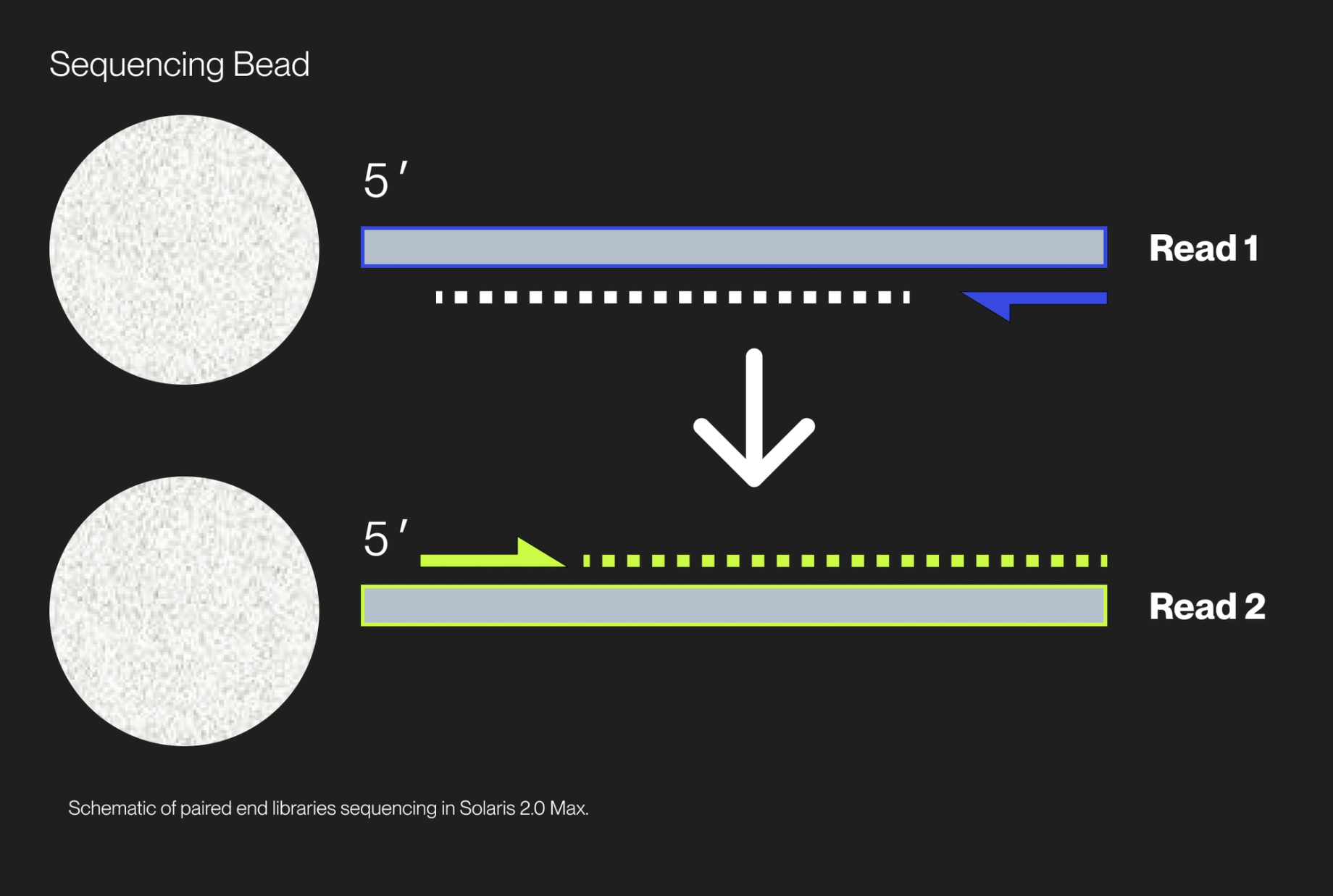
Our new Solaris 2.0 Max chemistry supports sequencing of paired-end libraries. Insert lengths can be adjusted during library preparation, with a default mean of 300 bp for germline WGS. This advancement, combined with the new 20-billion-bead wafer on the UG200, enables high-quality WGS at high-throughput and low cost, and supports a broad range of germline applications, including large-scale biobank sequencing, newborn screening, and rare genetic disease diagnostics.
Improved GC coverage with Solaris 2.0
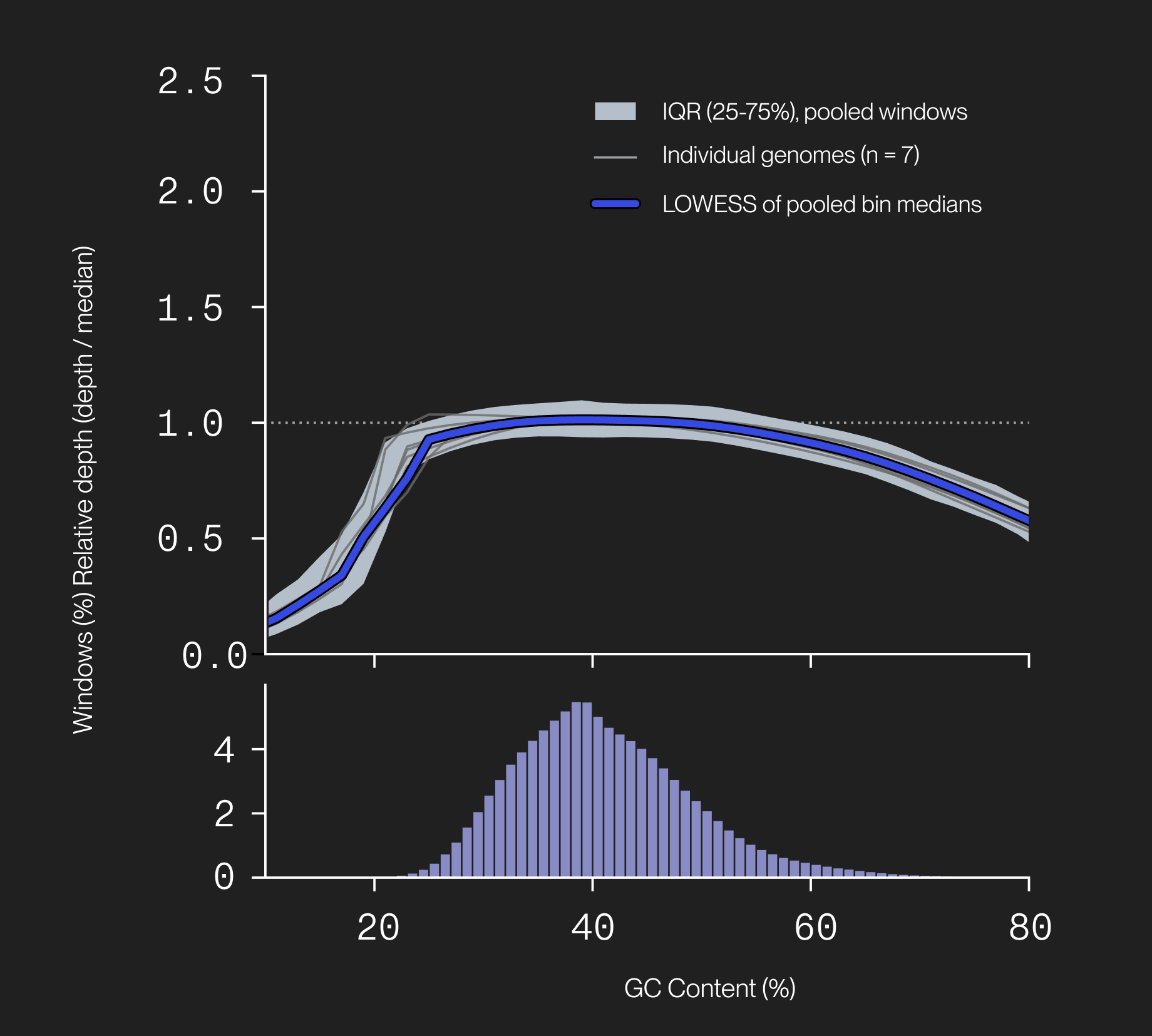
Solaris 2.0 Max uses isothermal amplification for bead amplification for reduced GC bias and even coverage uniformity across the genome. The top panel shows relative depth (window depth / genome autosomal median) vs GC, 500-bp autosomal windows, aggregated for the HG001–HG007 cell lines.
Download WGS application noteAccurate variant calling across genome
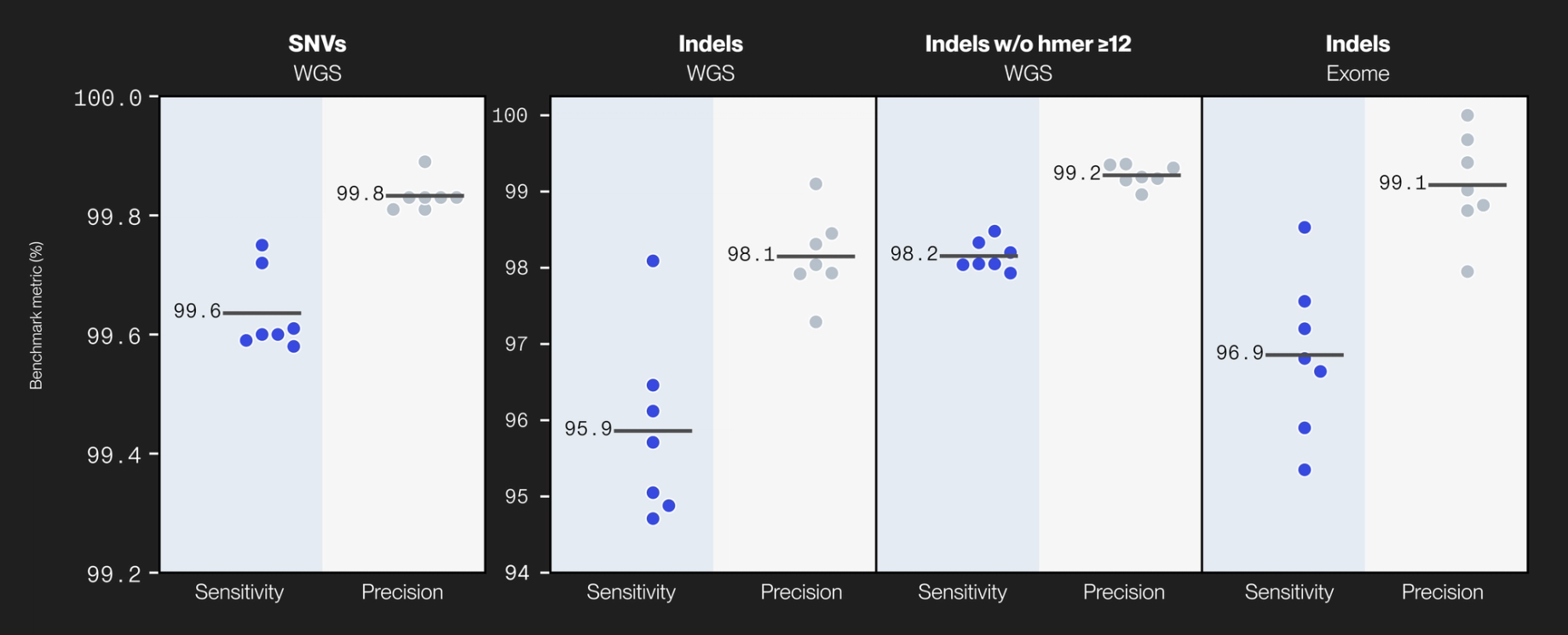
Small-variant calling accuracy of Solaris 2.0 Max paired-end WGS across seven GIAB reference cell lines. Reads from each cell line (HG001–HG007) were aligned to the HPRCv1.1 pangenome graph with Giraffe and surjected toGRCh38. Alignments were downsampled to 40x mean coverage and small variants were called with pangenome-aware DeepVariant using a model trained on Solaris 2.0 Max paired-end data and benchmarked against GIAB v4.2.1 truth sets within corresponding benchmark regions. Sensitivity(blue) and precision (gray) for SNVs, indels, indels excluding homopolymers ≥12 bp, and indels within exome coding sequences (the results for the SNVs in exonic regions were essentially the same as for WGS.). Each point is one cell line (HG001–HG007, n = 7). Horizontal lines and printed values indicate means.
Clinically relevant gene coverage
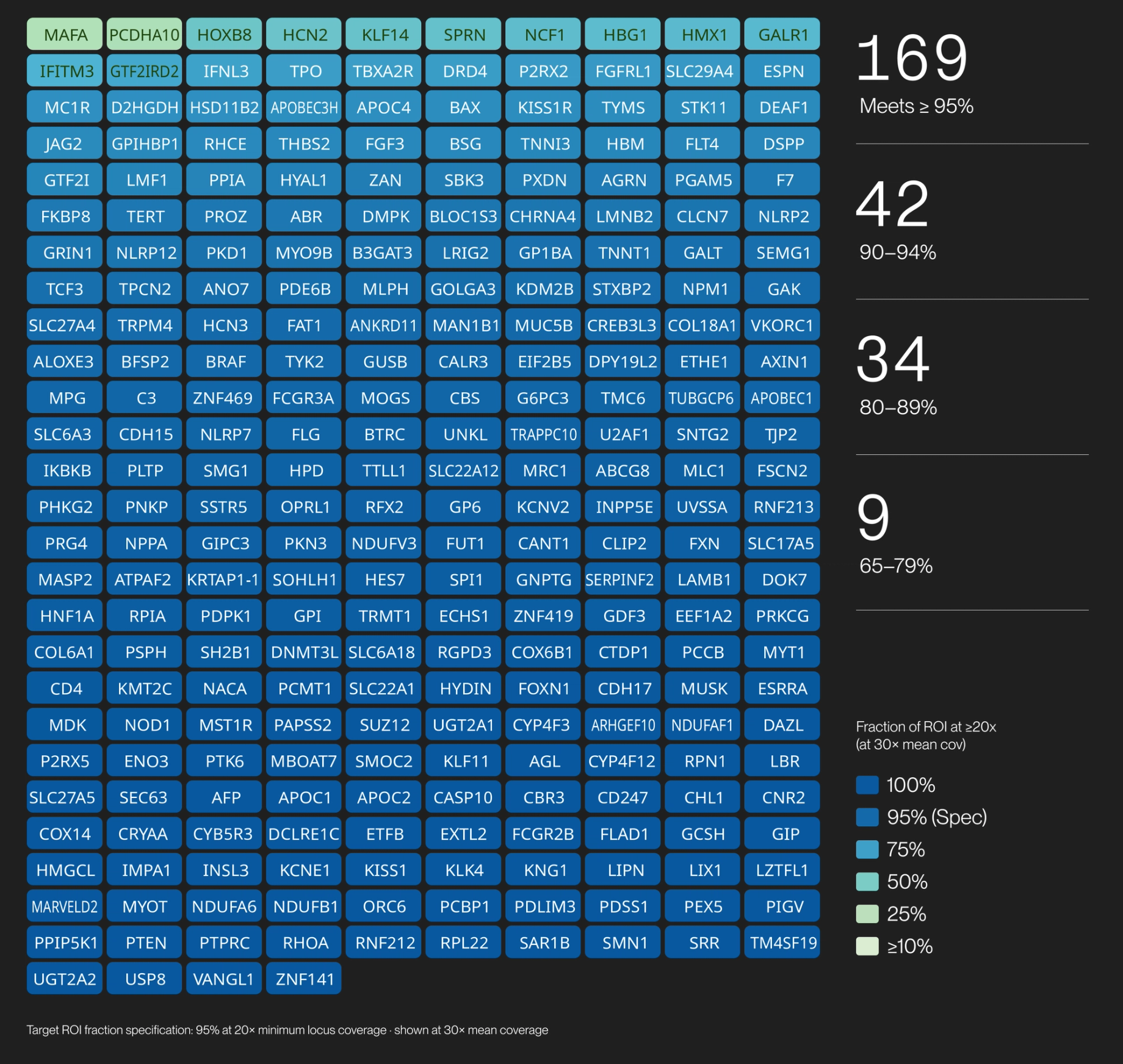
Improvements in high-GC coverage translate into more consistent and even depth across GC-rich, clinically relevant loci that are traditionally challenging for short-read sequencing workflows. ROI coverage at ≥20× read depth for 264 challenging medically relevant genes (HG002, 40× mean WGS). Tile color shows the percentage of each gene’s coding exons and splice sites covered at ≥20×, the depth associated with ≥99% heterozygous recall.
Download germline WGS application noteFaster workflow and fewer hands-on steps
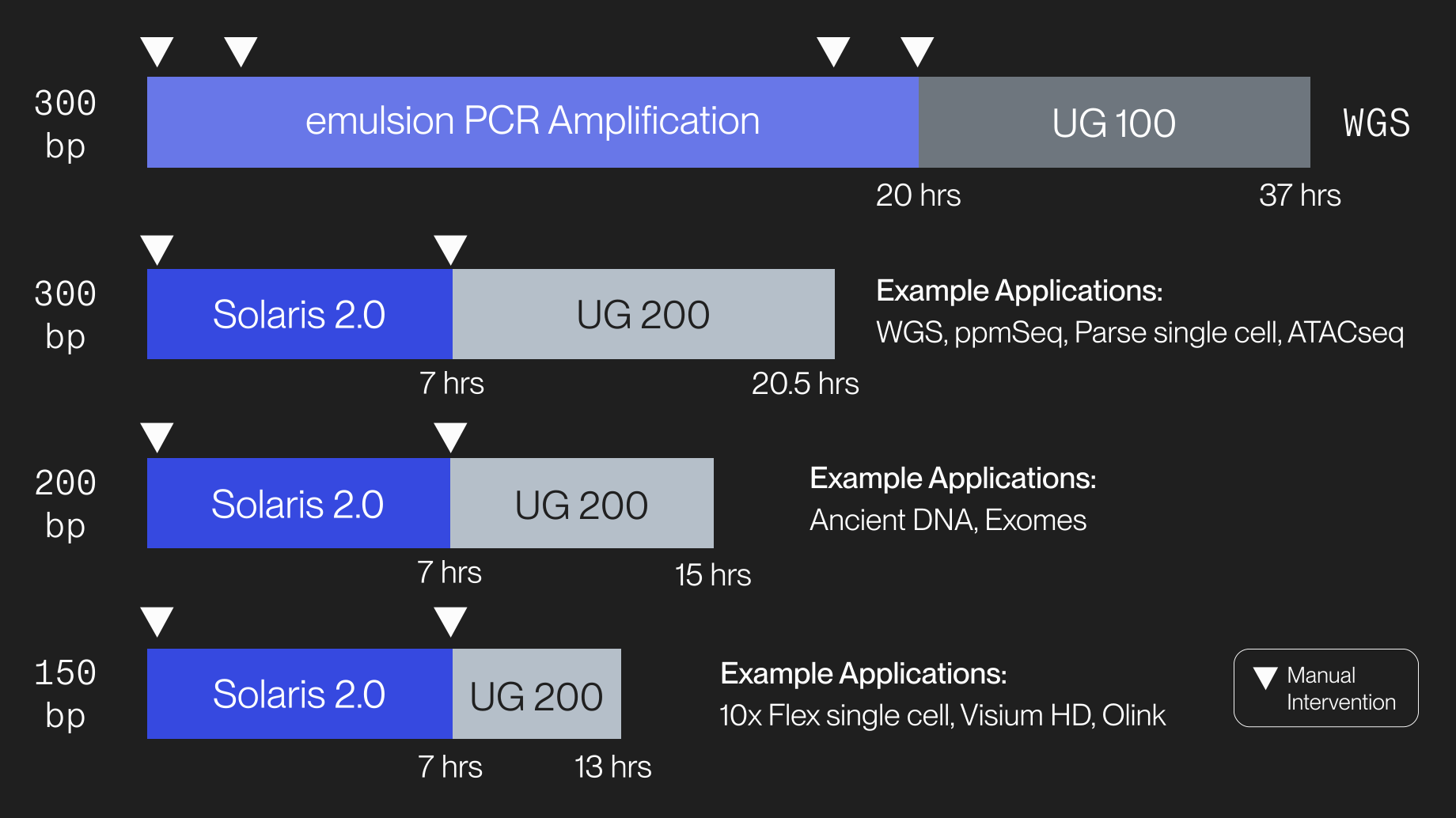
Solaris 2.0 provides a simplified 7-hour amplification workflow with hands-on time of only 10 minutes with one touch point. When using UG200 Series sequencers, libraries can be amplified and sequenced in 13 to 20.5 hours total depending on the sequencing read length.
Solaris 2.0 Free library prep
The Solaris 2.0 Free workflow offers PCR-free library prep compatible with leading library prep kits and accommodates a range of sample types and input amounts.
Highlighted Solaris 2.0 Free applications:
Germline whole genome sequencing
Somatic whole genome sequencing
ppmSeq for tumor/normal pairs
ppmSeq for liquid biopsy and MRD

Solaris 2.0 Flex library prep
The Solaris 2.0 Flex workflow allows for seamless adaptation of partial or full-length existing libraries generated from third-party library kits through a simple PCR.
Highlighted Solaris 2.0 Flex applications:
Single-cell sequencing
Methylation sequencing
RNA sequencing
Proteomics

Solaris 2.0 PCR-Free Adapters available from Ultima Genomics
Quantify Solaris 2.0 Free Libraries: NEBNext Library Quant Kit
Solaris 2.0 Flex Indexing PCR Primers available from Ultima Genomics
Solaris 2.0 library prep workflow highlights
| Workflow Name | Adapter & Primer Names | Sample indexing | DNA Type | DNA Input Range |
|---|---|---|---|---|
| Solaris 2.0 Free | Solaris 2.0 PCR-Free Adapters | 192 sample indices | Genomic DNA (gDNA) | 100 - 250 ng* |
| Solaris 2.0 Flex | Solaris 2.0 Indexing and UG-Universal Primers | 384 sample indices | Native or existing library | 10 ng* |
*DNA input amounts verified by Ultima Genomics.
A growing ecosystem of library prep partners
Start saving now.
Run your next project on an Ultima sequencer.
Certified Service Providers
Submit samples and start generating data on an Ultima sequencer. Access cost-effective and scalable sequencing with a growing network of global service providers rigorously vetted for their technical expertise and adherence to best practices.
Sequence with a CSP todayTechnology Access Program
Our Technology Access Program offers accessible entry to Ultima sequencing through our in-house applications lab. Sequence on our high-capacity fleet of Ultima sequencers and receive support at every step, from consultation through data analysis.
Discover our TAP offeringsBring Ultima into your lab
Interested in exploring how your lab can benefit from high-throughput, cost-effective sequencing? Learn how our novel use of open wafers and built-in automation is continuously driving the cost of sequencing down to accelerate omics at scale.
Speak with a Sales Specialist